

Sanjay Gowthaman – sanjay.g_cis@gemselearning.com
Anushka Anil Menon – anushkaanil.m_cis@gemselearning.com
Vaibhavi Parashar Shreedhar – vaibhavipara.s_cis@gemselearning.com
September 2nd, 2025
Edited by the YNPS Publications team.
Abstract:
This research investigates how age-related schemas impact testimonies of students, specifically year 7s (10–12-year-olds) and year 13s (17–18-year-olds) when exposed to a peculiar story. Based on Bartlett’s theory of reconstructive memory, we hypothesized that younger participants rely on simpler schemas and older participants rely on more complex schemas in their recall. We expect to find differences in how the 2 groups remember details.
Through interviews and written tasks, we have analyzed the differences in the patterns of recall of the same story and simultaneously uncovered any common trends involved in their schemas. We found patterns in memory distortion and the accuracy of the story. By the end of the study, it was clear that older students (17-18-year-olds) had a better recall of the story with its details, compared to the younger students (10-12-year-olds). The goal is to get a better understanding of how age affects memory and recall, which could modify how testimonies are gathered in schools or legal settings.
______________________________________________________________________________
Introduction
Eyewitness testimonies are a valuable tool in legal and investigative contexts. However, further research done by others, such as Sir Frederick Bartlett, has questioned its reliability. Frederick Bartlett developed the theory of reconstructive memory in 1932. His theory highlighted that a person does not have a replica of events in their memory. Instead, he believed that one’s memory is influenced by their schemas. Schemas, in simple terms, are mental frameworks that are often shaped by prior experiences and knowledge; they help a person have an interpretation of the world around thus affecting their memories. The theory suggests that a person goes through active recall when retrieving information. This has proven to distort one’s recall, especially when remembering ambiguous or odd details about an event.
An intriguing area of study is how the schemas of different year groups influence their recall. Schemas often evolve during various levels of cognitive development, learning experiences, and environmental exposure. Due to this fact, it is believed that the schemas of students from different year groups often vary on these factors. It could be said that the recall of younger students may rely on simpler schemas due to limited life experiences. On the contrary, older students may recall events using more complex schemas, which could be due to exposure to new things and a higher life experience compared to the younger students. These differences may account for the reasons for different recalls of the same event or story in various age groups.
This study aims to investigate how the schemas of different age groups affect their testimony. 2 groups of participants, students from ages 11-13 and ages 16-18, will receive the same events, and our group aims to address the schema-driven differences in the participants’ recall and memory distortions. Understanding these differences can provide insights into appropriate age schemas and improve ways to get testimonies from different age groups.
A practical application is that the results of this study will help law enforcement and authorities in education to develop efficient methods of collecting accurate testimonies from students of different age groups.
_____________________________________________________________________________
Literature review
The following consists of literature reviews of other studies sharing the same concept of memory and recollection.
Lost in The Mall (Loftus and Pickerell, 1995):
Jacqui Pickerell and Elizabeth Loftus researched 24 participants who believed they were taking a memory test. They asked the family members of the participants to tell them three stories about when the participants were about four to six years old, and asked about details of them being lost in a mall (which they had never been to). The family members created a fictional story; they gave the mall’s name, why they were shopping there, and how they got lost, for example. The participants were then made to read the four descriptions/stories and interviewed right after and a week later. It was found that 5 out of 24 participants (21%) recalled being lost in a mall, a few in elaborate detail. Participants rated the ‘Lost in the Mall’ memory to be less clear than others.
False Memories of Crime Commitment (Shaw and Porter, 2015):
Julia Shaw and Stephen Porter wanted to find out if they could implant a false memory of a crime committed by a participant within a laboratory experiment. They gathered about 70 Canadian college student participants who were randomly assigned to the “criminal condition” or the “non-criminal condition” through random allocation to control participant variables and were interviewed three times for three weeks.
Each time they were interviewed, they were asked to describe the ‘true event’ (details provided by family members) or the ‘fictional event’ of committing a crime when they were 10-14 years old (participants were led to believe false details provided by family members). The crimes were mostly assault, theft, and assault with weapons. The researchers then encouraged participants to practice visualization at night and used light social pressure by saying, “Most people can remember things if they try hard enough.”
By the third and final interview, 21 out of 30 participants (70%) in the “criminal condition” remembered false memories of committing a crime, some even adding elaborate details. Overall, this shows that when people question others in a particular way, it can lead to false memories.
Recollection improves with age – children’s and adults’ accounts of their childhood experiences:
This article mentioned a study that aimed to find out if recollection improved with age of people. There were three different age groups of participants in the research. One was adults, children who were around 5 years old, and young adolescents who were around 12-13 years old. Adults were interviewed about recent events and previous events from their childhood when they were around 5 years and 10 years old, and early teenage years, about 13 years old. The young adolescents and children were interviewed about recent events, as opposed to the adults. The results showed that adults tended to recall more about different points in their childhood and adolescence than 5-year-olds, despite having a longer retention period. The findings also have implications for understanding memory development and analyzing adults’ retrospective accounts in the courtroom, and retrospective studies with adults can overestimate the content of childhood memories.
Methodology
Empirical Research
Hypothesis:
Participants/Students aged 17-18 will have a better recall compared to participants/students aged 11-12.
| Independent Variable | Age group (11-12 years and 17-18 years) |
| Dependent Variable | How the story is recalled by each age group |
| Controlled Variable | Situational variables(lighting) |
| Possible Extraneous Variable | Noises from outside, Participants talking while the video is playing, |
| Confounding Variables | Noise from outside |
Materials:
- 20 participants (10 from year 7 and 10 from year 13).
- A peculiar story (made from scratch via AI).
- Pen and Paper during a written task.
- A well-controlled environment to show the story to the participants and for the written task.
- A voice recorder to record participants’ responses from the interview (done with consent).
Sampling:
We have used opportunity sampling to get the participants for this experiment. This is so we can get the participants easily available to us at the time. It is also the quickest and easiest way to get the required number of samples. We have achieved this by going around classes and asking for a maximum of 2 students to volunteer from each class. This way, we have ensured that a class will not get disrupted, as only 2 people will be out of their lessons instead of the whole sample size out of the lessons. We have provided a consent form for the participants so we can get their informed consent, which makes this study ethical.
Experimental design:
An independent measures design is the most suitable for this study. This is because our study required splitting participants into groups and making them go through only one condition of the study. We have achieved this by splitting our sample in half and making each half go through only one condition. A benefit of this method is that it prevents order effects from occurring because participants went through only one condition, preventing fatigue or practice. A drawback of this method is that there might be individual differences between the groups. To counter it, we have randomly allocated each participant to a condition.
Experiment type
This experiment is a lab experiment, as we conducted this in a controlled environment where we controlled the independent variables to get the dependent variables.
Procedure:
- Samples for one year will be collected first, and they will proceed to the first condition, where they will watch the peculiar story. We will show a form of consent so that we receive informed consent. We will tell them the instructions, but make sure we don’t reveal the purpose of the study.
- Immediately after watching the story, we will conduct an interference task by asking them to play a game of Blooket so that their recall will be purely out of their schemas. This task will last for approximately 5-7 minutes.
- Immediately after the interference task, half of the participants will be called one by one for an interview. This will be structured, and participants will be asked questions that probe for details from the story. These will be preset questions with preset answers, but the participants will not know if their response is the right answer or not.
- After the interview is done, the participant is asked to go back to the class to prevent them from exchanging any answers with each other.
- While the interviews are taking place, the other half of the participants will do a written task where they get 10 minutes to write about everything that they remember from the story.
- All participants are gathered and then debriefed on the procedure and what was expected from them
- The same will be repeated for the other year’s group, and the data will be analyzed.
The story that was shown to the participants:
The story below was turned into a video for the participants.
We used generative AI to give us a story.
The Door
There was a door in the middle of the desert. Bright orange, with a silver handle that felt cold, even under the sun. Nobody remembered who put it there, but everyone agreed it had always been.
Jasmin found it one afternoon while chasing a kite that had no string. She wasn’t supposed to go that far, but the kite whispered her name, so she followed.
The door was unlocked. She pushed it open and stepped through.
On the other side, it was snowing. A fish with antlers floated past her and asked, “Do you have the password?”
She didn’t.
“That’s okay,” it said, swimming backward into the sky. “Just don’t pick any flowers.”
Jasmin looked down. The ground was covered in flowers, all of them made of glass. They chimed softly when the snowflakes landed on them.
“Jasmin?” her mother’s voice called from somewhere, but it sounded like it was coming from underwater.
“I’m here!” she shouted, but no sound came out.
The door slammed behind her, and when she turned to look, it wasn’t there anymore.
Only the kite remained, tangled in a tree that didn’t exist moments before.
Method of collecting data:
We have collected the data from the interview by taking voice recordings of the participants’ responses. This was done with consent, and details of this were in the form of consent. The data from the written task is what the participants write on the sheet of paper, describing the story.
Data analysis:
We have used quantitative analysis to analyze the responses from the quiz since it’s a structured questionnaire disguised in an interview form. We have checked if the participants can actively recall details from the story using this method. We have used qualitative analysis to analyze the data from the written task since participants often use their own words when writing about the story. We have decided to analyze the data using our perspectives on what might be a correct detail or not. We are aware that this will result in observer bias. To counter it, we have used inter-rater reliability, where we have cross-checked our findings with another researcher or a teacher to make sure we do not make our findings subjective, as this would result in our study being unscientific.
Data representation:
We have presented the quantitative data (responses from the interview) in the form of a graph. We will calculate the meaning for each year’s group on how many details have been gotten right, and this will be shown in a bar chart. We presented qualitative data (our analysis from the written task) by showing quotes of a few sample answers that show us an understanding of the participants’ schemas. By doing this, we can get a basic idea of the schemas in the two age groups.
Ethical Concerns:
We understand that conducting this study may raise a few ethical concerns. One maybe is the lack of informed consent. To fix this, we have handed out consent forms to the participants so that they can get a clear picture of the procedures and any risks/ benefits in the study. Another ethical concern is the confidentiality of the participants. To counter it, we will make sure that any personal information, such as the names of the participants, will not be revealed during the presentation of this study.
______________________________________________________________________________
Results
Written Recall:
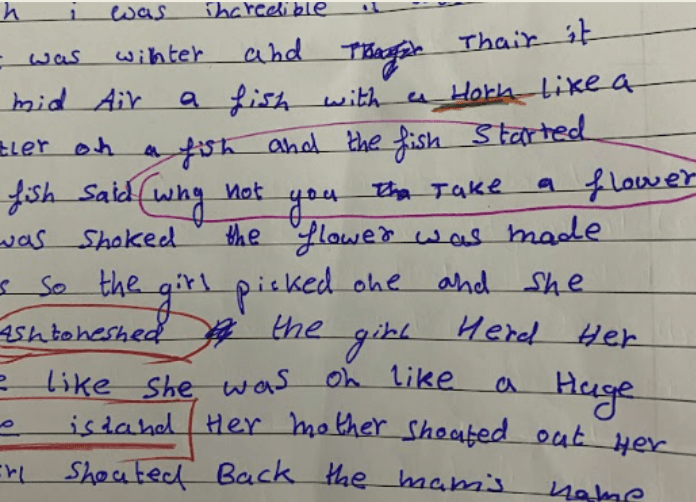
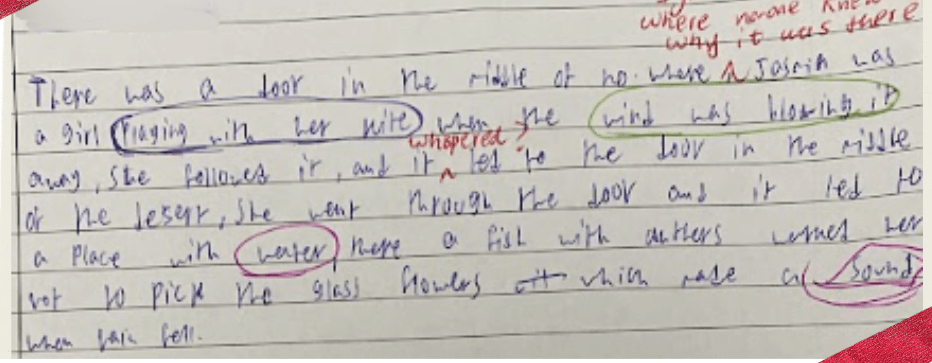
All the participants taking part in the written recall of the story had omitted some details. The participants wrote their own words for all the responses and omitted the unfamiliar details like the fact that the kite “whispered” Jasmine’s name and how Jasmine’s mother’s voice sounded like it was coming underwater. Year 12s (Aged 16-18) were able to get a better understanding of the plot compared to Year 7s (Aged 11-12). This could be because the story was easier to understand for the older participants due to their complex schemas.
45% of the participants also rationalized certain elements of the story to make it make sense to the participants. For example, a participant wrote that Jasmine was “playing with her kite”. This was not directly mentioned in the story, but it was understood by the participant. The participants aged 11-12 changed a few elements of the story in the hopes of making it sound normal. One participant mentioned that the fish offered Jasmine to pick a flower. This is incorrect because the fish warned her not to pick the flowers. The Year 12s (Aged 16-18) had a better recall of the story.
Interview/ Oral recall:
Participants were asked to recall the story. During this recall, all the participants used rationalization and omission to recall the text. Next, the participants were asked questions probing for details from the story. These structured questions had preset answers in them, but the participants did not know whether their answer was correct or incorrect. The younger group (Aged 11-12) had a poor accuracy of recalling details in the text, and out of seven, on average, the participant got only 1 detail right. The older group of participants (Aged 16-18), however, was able to get a score of 5/7 on average, showing efficient recall of details.
Visual Representation:
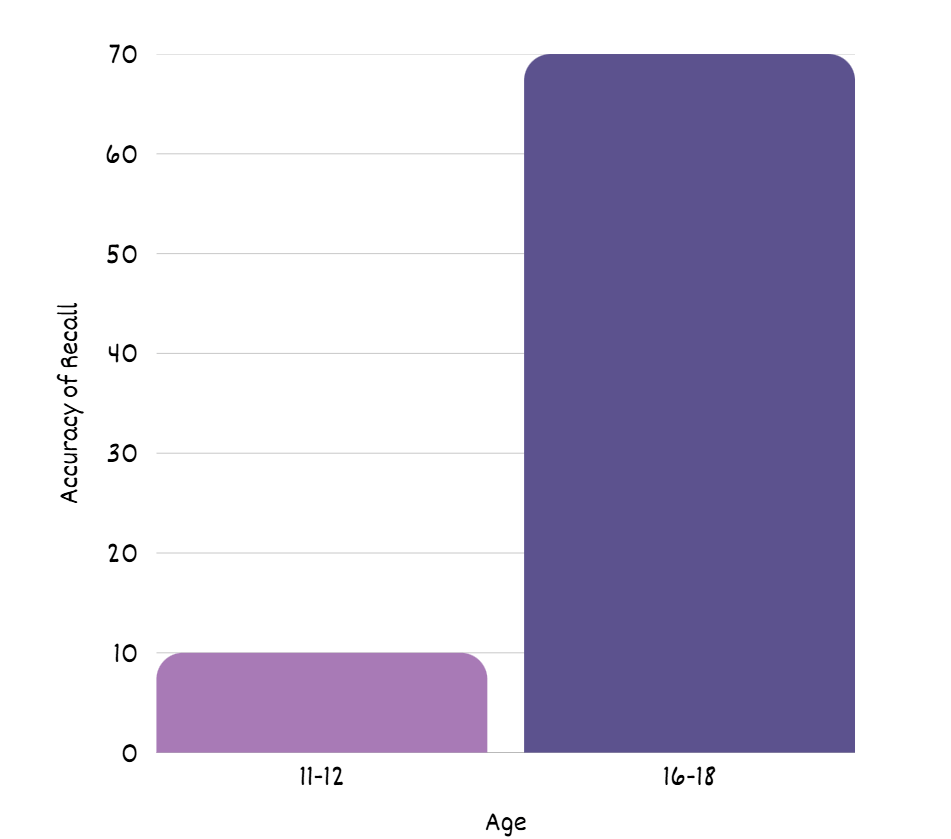
A bar chart to represent the levels of accuracy of recall. Students aged 11-12 had a 10% recall rate, whereas students aged 16-18 had a higher recall rate of 70%.
Discussion:
The results show that both age groups omitted and rationalized details from the peculiar story, but older participants (16–18 years) recalled more accurately than younger participants (11–12 years), likely due to their more complex schemas and broader life experiences. This supports our research question on how age-related schemas affect recall, as younger participants altered the story to make sense of it, leading to fewer correct details in their retellings and responses to structured questions. These findings align with the article from our literature review, How recollection improves with age: children’s and adults’ accounts of their childhood experiences, highlighting how older participants recalled more information and minor details due to their cognitive maturity.
Conclusion:
The findings of our study evidently show how age plays a significant role in the accuracy of how details of a story are remembered, perceived, and reconstructed by individuals, with older participants (16-18 years) demonstrating better recall of details than younger participants (11-13 years). Both age groups omitted and rationalized details; however, the younger participants had a larger tendency to distort any information that may be confusing or didn’t seem to align with their simpler schemas, unlike older participants, who have much broader views and ideas of everything around them and a complex cognitive framework, allowing more information to be retained and recalled accurately. These results support Bartlett’s theory and align with other research on the influence of development on memory, further reinforcing how schemas may be enhanced with age. The study helps highlight the importance of tailoring the ways of questioning and collecting testimonies of younger individuals, more prone to distorting details. Future research could perhaps use an expanded sample size and explore a wider range of cultural and educational backgrounds of participants, in addition to testing a wider range of ages, thus helping generalize and understand memory on a deeper level.
References
Arango-Muñoz, S., & Bermúdez, J. P. (2018, January 1). Remembering as a mental action. CORE Reader. https://core.ac.uk/reader/131216101
Dixon, T. (2018, November 19). Key Studies: Reconstructive Memory. IB Psychology. www.themantic-education.com/ibpsych/2018/11/19/key-studies-reconstructive-memory/.
Rowe, J. Reconstructive Memory AO1 AO2 AO3. PSYCHOLOGY WIZARD, www.psychologywizard.net/reconstructive-memory-ao1-ao2-ao3.html.
Tustin, K., & Hayne, H. (2018, January 29). Recollection improves with age: children’s and adults’ accounts of their childhood experiences. Memory (Hove, England), 27(1), 92–102. https://doi.org/10.1080/09658211.2018.1432661

 Youth Neuropsychology Society
Leave a reply to Joanna Cancel reply